

Traveling is a favorite activity for people in the United States. In fact, 71% of Americans took a vacation in 2024 with 22% of them taking 6 or more trips!1
Everyone loves to travel! Aside from getting a break from the norm of our daily lives, it gives us a chance to renew, refresh, and reflect on life. Joseph Tan even compares it to a spiritual experience, stating that “Touristic travel has served also as an occasion to nourish the spiritual longings of the human person”.2 I believe that any of us can agree if we stood on the sandy shore of the ocean, gazing at the vast waters before us…or felt small as we view jagged peaks of mountain ranges in front of us. Traveling truly can be a spiritual experience.

Our vacations can serve as a way to strengthen our own faith while also broadening the spiritual and historical perception of all tourists. Here are 5 ways we can achieve that:
1. We can see god’s creation
Psalm 19:1 (NASB) tells us, “The heavens tell of the glory of God; And their expanse declares the work of His hands.” As Christians, religion is not just in a building-it can be in the experience. Christian tourism that puts us right in the middle of God’s creative handiwork reminds us that God is present in everything. Tan reminds us that when we see beauty in nature, it gives humans “a sense of the great beauty that humanity is destined to see because humanity is destined to see God”.3 Even non-believers are given the opportunity to ponder the existence of a higher power when viewing the majesty of creation.
2. Fellowship with family and friends
Sometimes we all just need a break from the daily grind to get a change of scenery! I know that in my own personal family, we have two working adults, one son who is a recent college graduate and working his first job, another son at college, and a daughter who is homeschooling and entering her senior year. There are days where we all just seem to pass each other in the hallways! Traveling ensures that we are all off at the same time and we leave the stresses of life behind, getting to just enjoy time with each other. Studies have shown that vacations enhance family togetherness and the provide social stability to the family.4 We get the opportunity to focus on our family, but also focus on God and fellowship with Him. What about the nonbelievers around us? My family loves to take cruises. Our conversations around them, our modesty standards, and simple acts like family prayer are an example of God’s love and glory to them.
3. meet new people
Traveling offers the ability to meet new people that we may not normally see in our normal sphere of life. Darville believes that vacations can also serve as a “work trip to do the Lord’s business”.5 Genesis 1:28 tells us to “be fruitful, multiply, and fill the earth”, and he explains that a vacation and meeting new people gives us the opportunity to share our faith with others. Other travelers may be seeking to fill a void in their life through traveling as they search for validation, meaning, or identity–and we can show them how to have true happiness through Christ.
4. Experience other cultures
Traveling to other places or simply to a different culture than our own can be a very moving experience. One of the most meaningful travel experiences I experienced was seeing how others lived in the Dominican Republic. The lack of clean water, fear of safety, and poverty made me appreciative for the comfortable life I have.
Without having to travel far at all, I also have a very spiritual experience as I attended the funeral of my husband’s grandmother in Baltimore, just six hours from our own home in North Carolina. As Christians, we did not know much about his grandmother’s Catholic upbringing, so her funeral was a new experience for us. The grandeur of the church, the beautiful artwork inside the building, and the chants and rituals were oddly soothing. Though we have a completely different view than his family on faith and salvation, we both saw God’s faithfulness and love through some of the rituals.
Tan says that, “Tourists are often deeply moved because in the present culture they do not have the occasion to hear certain words, or hear certain themes or the concepts that religion talks about like life and death, good and evil, heaven and hell”.6 The cultural difference between my family’s Christian faith and the Catholic faith of his relatives spoke to us–how much more could it speak to nonbelievers who are being exposed to some of these concepts for the first time outside of their normal, everyday life.
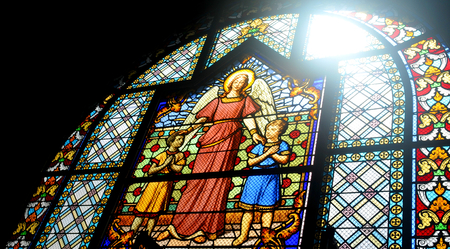
5. Tourists Can Learn through experiences, not sermons.
As the church, it is our responsibility to nourish the spiritual needs of travelers7, but often, they are overburdened by being “preached” to or are anxious to step foot into a church service. Cultural travel opportunities can deliver a welcome and opening invitation to nonbelievers by communicating a “rich, tale told well”8that is free of political agenda and overspiritualization. In a world where that seems to be difficult to find, we have the opportunity to expose all travelers to sacred art, architecture, and experiences in order to nourish their spiritual needs, letting God do the rest of the work in their hearts.
Traveling is wonderful, and we all look forward to getting a break away from everything. But when we book our hotels and make our itineraries, are we doing enough to ensure the trip is a faith experience for both us and those who may be around us?
- Fleck, Anna. “How Often Do Americans Travel?” Statista, Last modified February 17, 2025. https://www.statista.com/chart/31152/share-of-us-respondents-who-have-taken-private-trips/ ↩︎
- Tan, Joseph. “Religious Tourism and the New Evangelization: Theory and Best Practice in the Pastoral Promotion of the Church’s Cultural Heritage.” Church, Communication and Culture 3, no. 3 (12, 2018), https://go.openathens.net/redirector/liberty.edu?url=https://www.proquest.com/scholarly-journals/religious-tourism-new-evangelization-theory-best/docview/2278058746/se-2. ↩︎
- Ibid. ↩︎
- Lehto, Xinran Y, Xiaoxiao Fu, Hanliang Li, Lingqiang Zhou, and Xinran Y Lehto. “Vacation Benefits and Activities.” Journal of Hospitality & Tourism Research : The Professional Journal of the Council on Hotel, Restaurant and Institutional Education. 41, no. 3 (2017): 301–28. https://doi.org/10.1177/1096348013515921. ↩︎
- Darville, Jono. “Made to Travel: Traveling in Biblical Perspective.” Center for Faith and Culture, Last modified August 19, 2019. https://cfc.sebts.edu/faith-and-culture/made-to-travel-traveling-in-biblical-perspective/. ↩︎
- Tan, Joseph. “Religious Tourism and the New Evangelization: Theory and Best Practice in the Pastoral Promotion of the Church’s Cultural Heritage.” Church, Communication and Culture 3, no. 3 (12, 2018), https://go.openathens.net/redirector/liberty.edu?url=https://www.proquest.com/scholarly-journals/religious-tourism-new-evangelization-theory-best/docview/2278058746/se-2. ↩︎
- Ibid. ↩︎
- Roberts, Carey. “Christian Cultural Tourism”. Liberty University. ↩︎
 The Gephardts